For this Tuesday: 1) re-read Millay’s “Love Is Not All” and comment on a visual annotation posted by one of your classmates; 2) bring any questions about our “mystery text” assignment to class; 3) take a look at Ezra Pound’s poem, “In a Station of the Metro” as we prepare to jump into the swirling waters of literary modernism.
Category: Uncategorized
For Thursday (September 17)
For our next class (Thursday, September 17), here’s what you’ll want to have completed: 1) You only annotated the Frost poems with questions; now, return to the annotations for “The Road Not Taken” and “Stopping by Woods on a Snowy Evening” and answer the questions posed by others (one annotation on either of the poems); 2) Read and annotate Edna St. Vincent Millay’s “Love Is Not All” – – but here’s the rub: instead of annotating with words, make two annotations of Millay’s poem with only images (no words). Try to choose an image that adds something to the poem – – that explains or comments on the piece of text you’re annotating.
How do I annotate with images? It’s easy. Just highlight the text that you want to annotate. When the little annotation box pops up, don’t choose the “pencil” icon; instead, choose the little text box icon on the left. This will open up the usual annotation panel in the right column. There, you’ll see a little picture icon. Click on that icon and paste in the url of the the image you want to add. (Here’s a quick “how-to.” ) This will require that you search for appropriate images on the interwebs and copy their urls. Annotating with images may take some getting used to – – so relax and have some fun.
For Tuesday (Sept. 15)
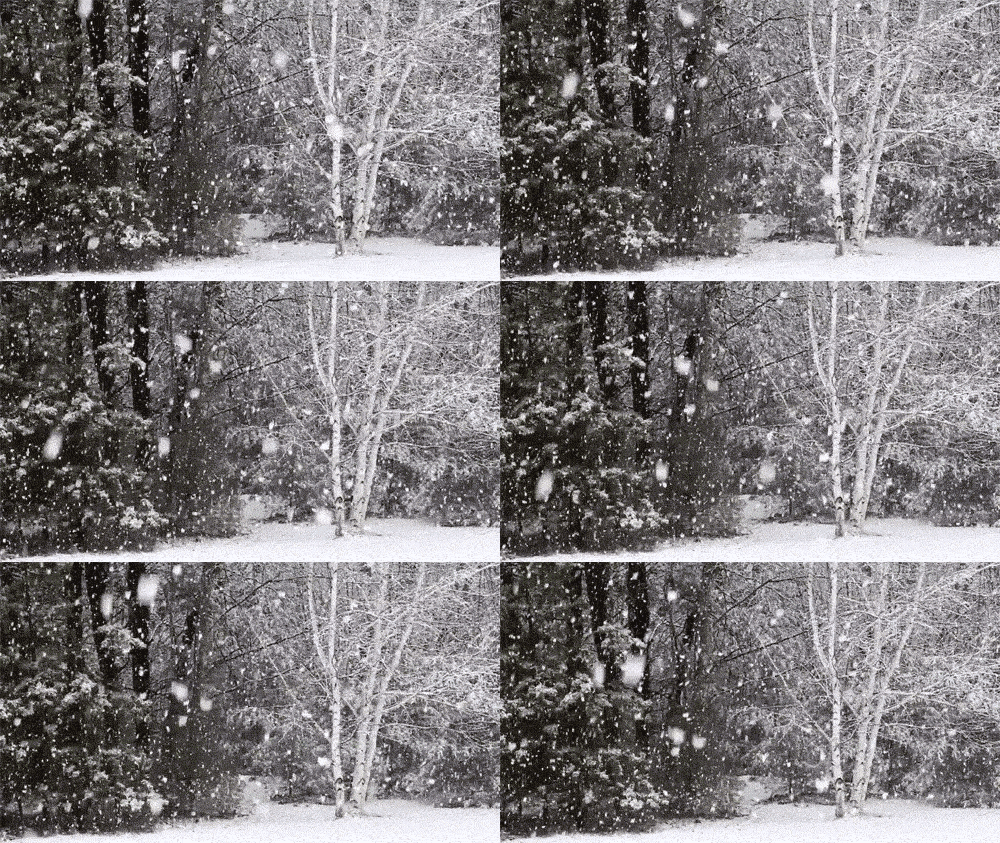
Things you’ll want to do for our next class on Tuesday, September 15: 1) Re-read the Edward Arlington Robinson poems – – “The Clerks” and “Mr. Flood’s Party“; 2) Read and annotate “The Road Not Taken” and “Stopping by Woods on a Snow Evening” by Robert Frost.
Nota Bene: Let’s try something different with the annotations of Frost. As you annotate the two poems, use the annotations to pose questions about the poem. E.g. no declarative statements of speculation, opinion, reflections etc. Only questions inspired by the language/words of the poem.
Extra Credit: Recalling our discussion of the house as setting in “The Yellow Wallpaper” and “the village” in Masters, rent a movie this weekend – – perhaps a horror or mystery movie – – that is set in a house or a village. What makes the house “creepy” or “mysterious”? How does the movie define the negative (and possibly positive) qualities of the village? Write this up in a page or so (handwritten or typed) and bring it to class. (This is not an essay, only your ruminations on the presentation of the house or village in the movie, e.g. no need for a thesis statement etc., only some reflections and examples.)
For Thursday (Sept. 10)
Several things for Thursday: 1) write up – – no more than two or three paragraphs – – what you learned about “the veil” and its various metaphorical meanings from your discussion with your classmates; 2) read all the Masters and Arlington Robinson poems – – but only annotate one, based on the quick grouping we did in class today; 3) think a little bit about the question I tried to raise at the end of class today, e.g. who’s the “crazy” one at the end of “The Yellow Wallpaper” – – John or the narrator?
For Tuesday (September 8)

For next Tuesday, be sure to: 1) read and annotate Charlotte Perkins Gilman’s short story, “The Yellow Wallpaper“; 2) write down one instance of the “veil” motif in Du Bois and bring it to class.
For the latter, Du Bois uses the actual term, “veil,” six times in his first chapter. These are pretty obvious instances. Can you find any less obvious or more figurative uses of the image of the “veil”? For example, think about the first sentence of the chapter – – where the “unasked question” appears to function like a veil – – or the use of “shadow,” “shades,” various kinds of darkness, etc. Quote from the Du Bois text, write that quote down on a piece of paper, and deliver that paper to class.
Here are a couple of things to think about as you read and annotate the Gilman story: 1) In “The Dynamo and the Virgin,” Adams sees the dynamo as representative of deeper, more sublime forces, forces that threaten his sense of order. Can you spot similar moments of disruptive, sublime forces in Gilman? 2) In “Of Our Spiritual Strivings,” Du Bois describes “[t]he shades of the prison-house clos[ing] round about us all.” Can you spot similar images or descriptions of confinement – – literal, but especially figurative – – in “The Yellow Wallpaper”? Again, these are only suggestions – – your annotations are your thing.
For Thursday (Sept. 3)
For Thursday, read and annotate “Of Our Spiritual Strivings,” a chapter from W.E.B. Du Bois’s The Souls of Black Folk (1903). (Remember, three quality annotations!)
A couple of things to keep in mind as you read: our discussion of Henry Adams’ doubled self in “The Dynamo and the Virgin”; the scene of miscommunication that Du Bois uses to open his chapter and, because it is the first chapter of Souls of Black Folks, to open his whole book.
Welcome!

Welcome to the motherblog for English 528: American Lit 1914-1960. Here you’ll find course information and updates about reading assignments, class projects, due dates, etc. All of our online texts are located in the sidebar to the right. You’ll also find a link to our syllabus to the right. Enjoy!