More Martin Eden for Wed.! Let’s read up to at least chapter 18.
For Monday (2/13)
Let’s read up to (at least) Chapter 12 in Martin Eden.
In our last class, I suggested that London’s novel revolves around a pretty durable way of representing class difference. Consider the novel’s invocation of “hands.” For instance, this from Chapter 4:
“Well he knew why their hands were rough; but this hand of hers . . . It was soft because [Ruth] had never used it to work with. The gulf yawned between her and him at the awesome thought of a person who did not have to work for a living. . . . He had worked himself; his first memories seemed connected with work, and all his family had worked. There was Gertrude. When her hands were not hard from the endless housework, they were swollen and red like boiled beef, what of the washing. And there was his sister Marian. She had worked in the cannery the preceding summer, and her slim, pretty hands were all scarred with the tomato-knives. Besides, the tips of two of her fingers had been left in the cutting machine at the paper-box factory the preceding winter. He remembered the hard palms of his mother as she lay in her coffin. And his father had worked to the last fading gasp; the horned growth on his hands must have been half an inch thick when he died.”
From this simple distinction between middle-class hands and working-class hands, we can trace a whole system of categories for distinguishing between classes: soft vs. rough; smooth vs. scarred; clean vs. dirty; beautiful vs. ugly; form vs. function; refined vs. vulgar; reason vs. instinct; civilized vs. savage; culture vs. nature; mind vs. body; the cooked vs. the raw.
Can you find a contemporary example of the way this system of representation works to distinguish or mark the difference between classes? (Previously, I offered the Edward vs. Jacob conflict that structures the Twilight novels/movies.) Bring your example into class on Monday.
For Wed. (2/8)
For Wed., let’s read the first five chapters of Martin Eden.
For Monday (2/26)
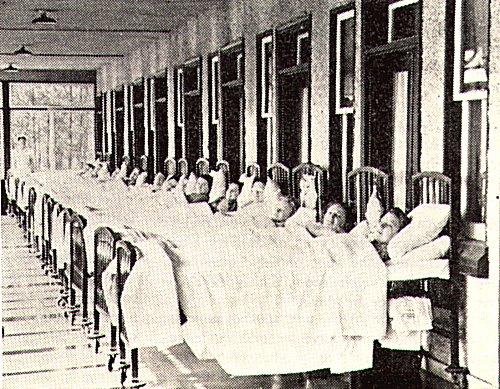
Let’s read Gilman’s “The Yellow Wall Paper.” Some of you may have read the story before – -but this time, read it with an eye on work. E.g. who does what kind of work?
For Wed. (2/1)
Before moving on to “The Yellow Wallpaper,” let’s pause for a minute to see if we’re done with Davis’s “Life in the Iron Mills.” Come to class tomorrow with at least one good question about Davis’s text or about our discussion of the text.
For Monday (1/30)

For Monday, finish reading Rebecca Harding Davis’s “Life in the Iron Mills.” Pay particular attention to the “Korl woman” scene. What differences would you note between Hugh’s statue and “The Greek Slave” by Hiram Powers (see above), sculpted about a decade before Davis published her story and one of the most famous mid-19th century American works of art.
For Wed. (January 25)

For Wed., January 25, start reading Rebecca Harding Davis‘s “Life in the Iron Mills.” You can read the whole novella/short story, but we’ll only discuss up to the paragraph that begins with this sentence: “I want you to come down and look at this Wolfe . . . .” This is about halfway through the text. As you read, think about who is telling you this story.
Welcome!
Welcome to the coursesite for English 630.2, Literature of Labor. Here, you’ll find information and updates about the course (including the syllabus via the link to the right), announcements, assignments, and various treats. Check back frequently.