Don’t forget: if you haven’t already you need to track a motif through the rest of “The Waste Land.”
For Thursday, let’s talk about Hemingway. Read the first three texts in “In Our Time“: “On the Quai at Smyrna,” “Chapter 1,” and “Indian Camp.”
U.S. Literature 1914 – 1960
Don’t forget: if you haven’t already you need to track a motif through the rest of “The Waste Land.”
For Thursday, let’s talk about Hemingway. Read the first three texts in “In Our Time“: “On the Quai at Smyrna,” “Chapter 1,” and “Indian Camp.”
In our chat about Eliot’s “Waste Land” on Tuesday, I tried to outline a way of reading the poem faithful to its radical, collage form. Keeping track of a motif as it appears throughout Eliot’s long poem offers us a way of noticing patterns and of thinking about how the poem uses repetition to develop its meanings. Recall some of the motifs I pointed to:
zombies: “A crowd flowed over London Bridge, so many,/I had not thought death had undone so many.”
wet/dry: “Here, said she,/Is your card, the drowned Phoenician Sailor,/(Those are pearls that were his eyes. Look!)”
exile: “Frisch weht der Wind/Der Heimat zu/Mein Irisch Kind,/Wo weilest du?”
fragments/fragmentation: “A heap of broken images”
polyglossia/Babel: ““You! hypocrite lecteur!—mon semblable,—mon frère!”
men and women/romance: “Your arms full, and your hair wet, I could not/Speak, and my eyes failed . . .”
nature: lilacs, tubers, hyacinths, “brown fog”
(As you can see even from these examples, motfs are not exclusionary – – sometimes they intersect and double-up.)
Here is your goal for our next foray into “The Waste Land“: choose one of these motifs; find three instances of the motif in the rest of the poem; annotate each instance, explain how this motif connects to other instances.
Let’s start reading Eliot’s The Waste Land. For Thursday and Tuesday, let’s just read the first section of the poem – – “Burial of the Dead.” Make at least three annotations. These annotations should only consist of questions, questions or confusions prompted by lines or phrases in the poem. I.e. don’t worry about “interpreting” the poem, just use the annotations to record your experience of the poem.
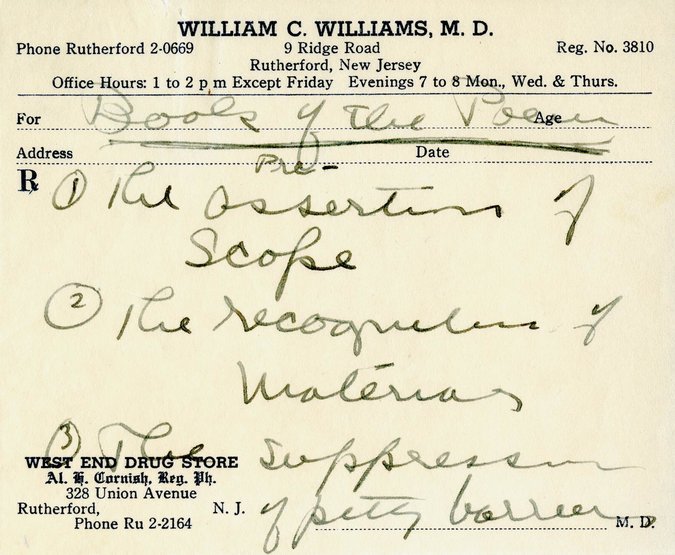
For Thursday (10/5), read these poems by William Carlos Williams. I’m particularly interested in “To Elsie.” Make three annotations anywhere you like.
For Tuesday (10/10), you’ll want to read the wild poem – – “Sacred Emily” by Gertrude Stein. Make three annotations – – but let’s do something different, more modernist with these annotations. Make three visual annotations so that we create a kind of visual collage of the poem. The visual annotations should be inspired by – – but not limited to illustrating – – the poem, i.e. you have as much leeway as you like to attach images to lines and words.