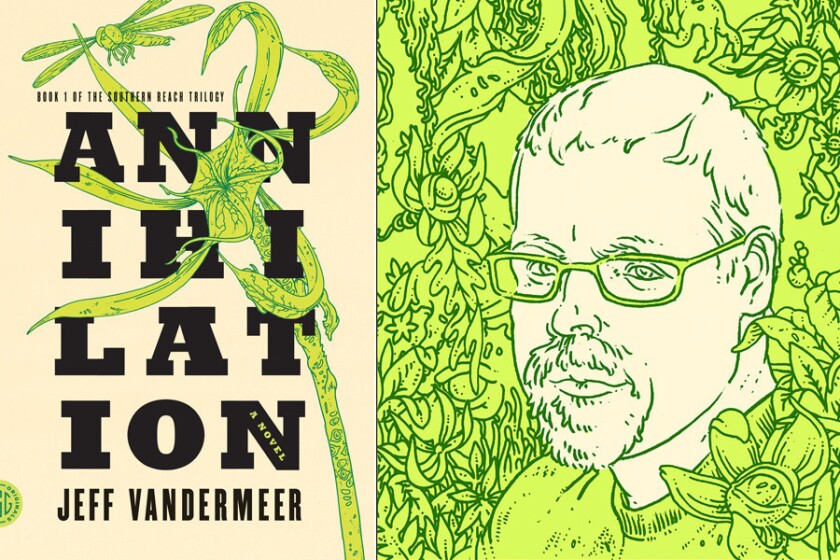
Let’s spend the next couple of weeks reading Jeff VanderMeer’s Annihilation (2014). Your first reading journal entry on Annihilation will be due next Thursday, April 16, at 5 p.m. For this entry, read up to the end of Chapter 2: Integration. To make your entry, simply insert a page break (Insert 
VanderMeer published Annihilation in 2014 as the first installment of his “Southern Reach” trilogy – – followed by Authority (2014) and Acceptance (2014). (For those of you who’ve seen Alex Garland’s 2018 movie version of Annihilation – – the book is very different.) Prior to the “Southern Reach” trilogy VanderMeer had established himself as a leading figure – – author, editor, anthologist – – of the “new weird” movement in contemporary literature/narrative. It’s hard to define this subgenre, except maybe to say that “weird” fiction appears to bend the boundaries of horror, science fiction, and fantasy. “Weird” narrative typically explores worlds that are very much like ours, but at the same time eerily and strangely off-center or off-kilter. Many readers and critics point to Poe, Lovecraft, Borges, and Gabriel Garcia Marquez as precedents for the “new weird.” (Besides VanderMeer, a couple of my favorite “new weird” writers are Finnish writer, Leena Krohn, and American short story writer, Kelly Link.)
At the center of Annihilation and the “Southern Reach” trilogy is Area X – – an anomalous zone that emerges largely without explanation somewhere on the U.S. coast. Annihilation‘s interest in place and setting borrows from a variety of sources: ecology and environmentalism, the “world-building” framework of fantasy fiction, and even MMORPGs (Massively Multiplayer Online Role-Playing Games) like Runescape, EverQuest, and World of Warcraft. In a sense, our hero – – the Biologist – – simply explores a new, strange environment, a place that both challenges and enchants her. Whether or not Annihilation also borrows a kind of detective plot – – decoding the truth beneath the mystery of Area X – – is a question that pushes the reader forward even as it seems to offer less and less interest to the Biologist. I think first kind of question to ask yourself as you start Annhiliation is pretty simple: what makes this place strange? That is: what elements of the novel’s setting are weird and what makes them weird? Can you see any patterns in this weirdness? How do the various characters react to the strange features of Area X? What does this tell us about the characters and the ways they think?
In a lovely interview, VanderMeer talks about encountering and recognizing the “unexpected eruptions of life” in “broken places” – – environments that have been disrupted, fragmented, and transformed by human activity:
The Biologist also seems to be drawn to “broken places” even before she enters Area X. Early in the narrative, she declares that she qualifies for the expedition because she “specialized in transitional environments.” Later, she tells us that she became a biologist mainly thanks to the overgrown swimming pool in her backyard. Take a look at this description of the “abandoned” pool and the way the Biologist describes her relationship to it. Is the swimming pool at all like Area X? Does this fugitive episode help us to understand her relationship to Area X? As importantly, how does the Biologist’s relationship to Area X change over the first two chapters? How does her relationship to Area X differ from her companions’ relationship?
For me, one of the most interesting things about Annihilation is our relationship to the Biologist – – who is both a narrator and (a kind of) protagonist. What do we know about the Biologist? How important is her identity as a scientist to her character and her experience in Area X? What quirks and contradictions can you see in her character? What does she seem to “see” or recognize in Area X that other characters don’t? What do you make of her relationship to her comrades? And, what do you think about her as a narrator? She shows us Area X but she also seems to hide a lot from us. Can you make sense of which events, facts, experiences, beliefs she chooses to disclose and which she chooses to conceal? How much do you trust her as a narrator?
Finally, a motif to think about as you move forward in the novel. Later on, we find out that the Biologist’s husband has a “pet” name for her: “ghost bird.” The term “ghost” comes up a lot in the first couple of chapters: “ghosting through her syntax,” “a ghosting of prior words,” “ghost scripts,” “the ghost of some hypnotic suggestion,” the apparition of the Biologist’s husband in the kitchen, etc. What is a ghost? Is Area X a haunted place? Sometimes, I wonder if Annihilation might actually be a fundamental text in the emerging discipline of “hauntology.”